Persistent KV Cache: Own Your Context Caching Lifecycle


In our last post, we made a simple argument. The cheapest token is the one you never recompute.
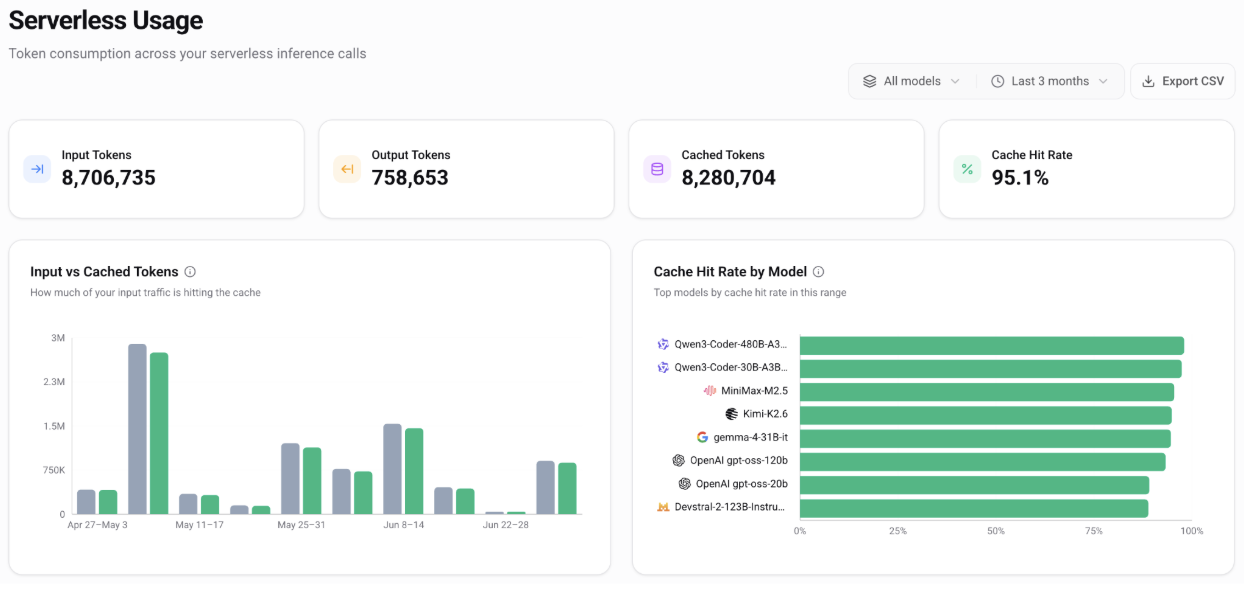
Every Tensormesh Inference customer already benefits from that principle within a single request. In-memory KV cache hits happen automatically, cached input tokens are billed at $0, and there is no setup required. The larger opportunity appears when you look beyond a single request and start thinking about how context is reused across sessions, users, and workloads.
Most serverless inference platforms treat cache state as temporary infrastructure. Once a session ends, the cache disappears. The next request arrives carrying the same system prompt, the same tool definitions, the same retrieved documents, and often the same conversation context. Even though those tokens may have been processed moments earlier, the entire prefix must be encoded again.
The problem is not that persistence is difficult. The problem is that developers rarely control the cache lifecycle. Questions about how long cache entries live, what they contain, how capacity is allocated, and when stale entries should be removed are typically answered by the platform provider. Tensormesh Inference takes a different approach by giving developers direct ownership over those decisions.
The Cost Case for Persistent KV Cache
The economics of persistent KV cache are surprisingly straightforward because storage is dramatically less expensive than the GPU compute required to regenerate the same KV state over and over again.
Consider a 32,000-token system prefix that is re-encoded 2,000 times each day. At $0.15 per million input tokens, that workload costs roughly $288 per month in recomputation alone. Storing that same prefix in a persistent KV cache bucket costs only a fraction of that amount while eliminating the need to repeatedly pay for the same work.
The difference becomes much more significant as traffic scales. A customer support assistant with a 24,000-token shared prefix and 150,000 daily sessions can generate more than $15,000 per month in repeated encoding costs. The storage cost remains largely unchanged because the cached state already exists and can be reused indefinitely.
As applications mature, the gap continues to widen. System prompts become more sophisticated, tool definitions expand, knowledge bases grow larger, and conversation histories become longer. Every stable prefix that can be reused increases the value of persistence and further separates the cost of storage from the cost of recomputation.
At that point, the decision becomes clear. You can continue paying GPU prices to regenerate context, or you can pay storage prices to preserve it. For many production AI workloads, that difference represents one of the largest optimization opportunities available today.
KV Caching vs. Context Caching: Where Persistence Fits
Google’s Gemini Context Caching provides a useful framework for understanding where persistence fits into the inference stack.
KV caching is the underlying mechanism. During inference, KV state allows attention computations to be reused instead of recalculated, reducing the amount of work required to process long contexts efficiently. Context caching is the product feature built on top of that mechanism. Rather than limiting KV state to a single request, context caching preserves it across requests so the same context does not need to be encoded repeatedly.
Viewed through that lens, Tensormesh External Storage provides context caching for open-weight models. The broader industry has already validated the value of this approach. The differences emerge when you look at how much control developers actually receive.
Anthropic offers prompt caching with a fixed five-minute lifetime and no developer-controlled retention settings. OpenAI follows a similar model. Google extends the concept further by allowing developers to create cache entries, manage expiration times, and delete entries directly. Even so, those caches remain tied to Gemini models, operate entirely within Google’s infrastructure, and bill based on cached token-hours.
Tensormesh approaches the problem differently in three areas that matter most for production deployments.
Subscription, Not Per-Token-Hour
Google bills context caching based on the number of cached tokens and the amount of time they remain stored. Cache reads receive a significant discount, yet costs still scale alongside usage and retention duration.
Tensormesh Inference uses a flat monthly subscription model for persistent KV cache. Cache reads are free, and costs remain predictable as traffic grows. For teams operating recurring workloads, the economics become easier to forecast because the bill is tied to storage capacity rather than request volume.
Predictability matters because infrastructure decisions should not become harder as applications scale. A storage subscription allows teams to understand costs in advance rather than continually recalculating the relationship between cache retention, traffic volume, and token consumption.
Portable, Not Gemini-Only
Google Context Caching is designed specifically for Gemini models. Tensormesh Inference works across DeepSeek, Qwen, Kimi, gpt-oss, and the broader serverless model lineup. The same infrastructure is powered by the open-source LMCache engine, allowing developers to apply persistent caching across a wide range of open-weight deployments.
Model flexibility becomes increasingly important as AI applications mature. Most teams are constantly evaluating new models, balancing quality against latency, context length, and cost. The value of context caching increases when it follows your workload rather than remaining tied to a specific model provider.
Persistent KV cache should be infrastructure that survives model changes. Developers should not have to choose between caching efficiency and model flexibility.
Lifecycle Control, Not Just TTL
Time-to-live settings are useful, although expiration is only one piece of cache management.
Tensormesh provides visibility into cache utilization, storage consumption, and model-level allocation. Developers can inspect how capacity is being used, understand where cache state originates, and reset storage whenever application requirements change. TTL is one lifecycle control. Ownership includes visibility, growth, maintenance, and cleanup.
Those capabilities become increasingly important as AI applications evolve. A cache is not a static asset. It changes alongside prompts, workflows, models, and retrieval systems. Managing that lifecycle effectively requires more than a timer that determines when entries expire.
Why KV Cache Ownership Matters
The economics of an AI application are never static. Prompts evolve, tool definitions expand, knowledge bases are updated, retrieval pipelines are redesigned, and models are replaced with faster or less expensive alternatives. Every one of those changes affects the validity of existing cache entries.
When developers have no visibility into cache state, stale entries can quietly consume resources without providing value. In some situations, outdated state can even remain associated with prompt structures that no longer match the application. Storage capacity becomes harder to manage because the underlying data is effectively invisible.
Owning the cache changes that dynamic entirely.
Within Tensormesh Inference, Operations → Storage provides a live view of bucket utilization along with a breakdown of storage usage by model. Teams can identify outdated prompt templates, inactive models, or obsolete cache entries that no longer justify the space they consume. Capacity planning becomes a data-driven process rather than a guess based on opaque platform policies.
The result is a cache that behaves like infrastructure you control instead of infrastructure you borrow.
Cache Lifecycle Control in Three Moves
External Storage provides a persistent KV cache bucket that survives across requests, sessions, and serving replicas. System prompts, conversation prefixes, tool definitions, and shared document context remain available for reuse long after the original request completes. The real value comes from the ability to manage that state as your application evolves.
Start Small
Every account begins with a free 0 GB tier, giving teams an opportunity to measure cache effectiveness, observe hit-rate behavior, and understand how context reuse appears within their own workload before committing to additional capacity. There are no setup costs, minimum commitments, or penalties for remaining small while you evaluate the economics.
This allows developers to validate the impact of persistent KV cache using their own traffic patterns rather than relying on theoretical estimates. Once the value becomes clear, expanding capacity becomes a straightforward decision.
Extend When You Grow
As applications accumulate more reusable context, storage capacity can be expanded through Bronze, Silver, and Gold tiers. Upgrades happen immediately without data loss or migration requirements, allowing capacity to grow alongside the application without forcing teams to predict infrastructure requirements months in advance.
The result is a storage model that grows naturally with demand. Teams can focus on application development instead of capacity planning exercises that often become outdated before they are completed.
Reset When You Change
Applications evolve, and cache state should evolve with them. A new system prompt, a model migration, or a redesigned retrieval pipeline can instantly make older cache entries obsolete. Continuing to store that data provides little value and unnecessarily consumes capacity.
When that happens, developers can clear the bucket and rebuild the cache against the latest application state. Fresh requests repopulate the cache, allowing the workload to quickly return to benefiting from $0 cached input tokens while ensuring that only relevant context remains stored.
This capability represents one of the most important differences between owning the cache and simply renting access to it. Renting means operating within a provider’s retention policies. Ownership means deciding when state lives and when it disappears based on the needs of your application.
When to Start with Persistent KV Cache
Some workloads begin seeing value from persistent KV cache almost immediately. Applications with large, stable prefixes are ideal candidates. Agent system prompts, customer support instructions, knowledge-base context, shared workflow definitions, and other reusable context can all benefit from being encoded once and reused repeatedly. The value increases further when requests share context across users, sessions, or recurring workflows.
The free 0 GB tier provides a low-risk way to observe these patterns in production. Once cache hit rates stabilize and the economics become clear, teams can subscribe to the storage tier that matches their working set and expand as needed.
The goal is not to provision more storage than necessary. The goal is to bring cache management under your control. When developers can see their cache, size it appropriately, expand it as applications grow, and reset it when requirements change, context becomes an asset rather than a recurring cost.
Persistent KV cache is ultimately about more than reducing inference spend. It is about owning the lifecycle of one of the most valuable resources in modern AI infrastructure.
Subscribe to a tier under Operations → Storage, or talk to an engineer if you want help sizing the bucket against your actual traffic.
.png)


.png)