Building Production AI Infrastructure: Lessons from AI at Hyperscale

Building Production AI Infrastructure: Lessons from AI at Hyperscale
Based on an interview with Qian Cao, Founding Engineer at Tensormesh
Imagine it's three o'clock in the morning on a holiday weekend when a customer's AI application suddenly stops responding. GPU utilization appears healthy, the models are online, and every benchmark suggests the system should be performing well. Yet latency is climbing, requests are backing up, and users are left waiting.
This is the difference between building AI systems that perform well in benchmarks and building production AI infrastructure that delivers reliable, scalable LLM inference. As enterprise AI adoption accelerates, organizations need AI inference infrastructure that maximizes GPU utilization, minimizes latency, and consistently performs under real world production workloads, not just in controlled tests.
At Tensormesh, these production realities influence every engineering decision. Experience building enterprise AI infrastructure at hyperscale reinforces a simple lesson: the engineering challenges that matter most are often the ones benchmarks never measure.
Why AI Infrastructure Changes at Hyperscale
Many infrastructure decisions that seem relatively minor at smaller scales become mission critical once workloads begin serving thousands or even millions of inference requests.
At lower volumes, additional GPUs can compensate for inefficient scheduling, and redundant computation may have little impact on overall cost. As demand grows, however, those same inefficiencies quickly become expensive.
Every layer of the infrastructure begins operating under greater pressure. GPU utilization becomes a business metric rather than simply an engineering metric. Storage systems experience entirely different access patterns. Networking becomes more complex. Resource contention becomes a constant consideration rather than an occasional problem.
Efficiency becomes equally important. Recomputing the same context repeatedly is no longer sustainable when every unnecessary GPU cycle increases both latency and infrastructure costs.
Scaling AI inference infrastructure is not simply about adding more hardware. It requires rethinking how the entire system operates under real production workloads while maximizing GPU efficiency and delivering predictable performance.
Large Organizations and Startups Solve Different Problems
Large technology companies and startups approach AI infrastructure from very different perspectives because they operate under different constraints.
Organizations serving massive customer bases naturally prioritize stability, backward compatibility, and operational consistency. Engineering teams spend significant time maintaining existing systems, responding to production incidents, and ensuring infrastructure remains dependable for millions of users.
Startups have a different advantage. Smaller engineering teams can iterate faster, experiment with new architectures, and make reversible technical decisions as AI workloads evolve. Without years of accumulated operational complexity, they can often adapt more quickly to emerging challenges in LLM deployment and AI serving infrastructure.
Neither approach is inherently better. Large organizations optimize for reliability and consistency at scale, while startups often optimize for speed, innovation, and rapid iteration. Both perspectives contribute to the evolution of modern AI infrastructure.
Why AI Benchmarks Don't Predict Production AI Performance
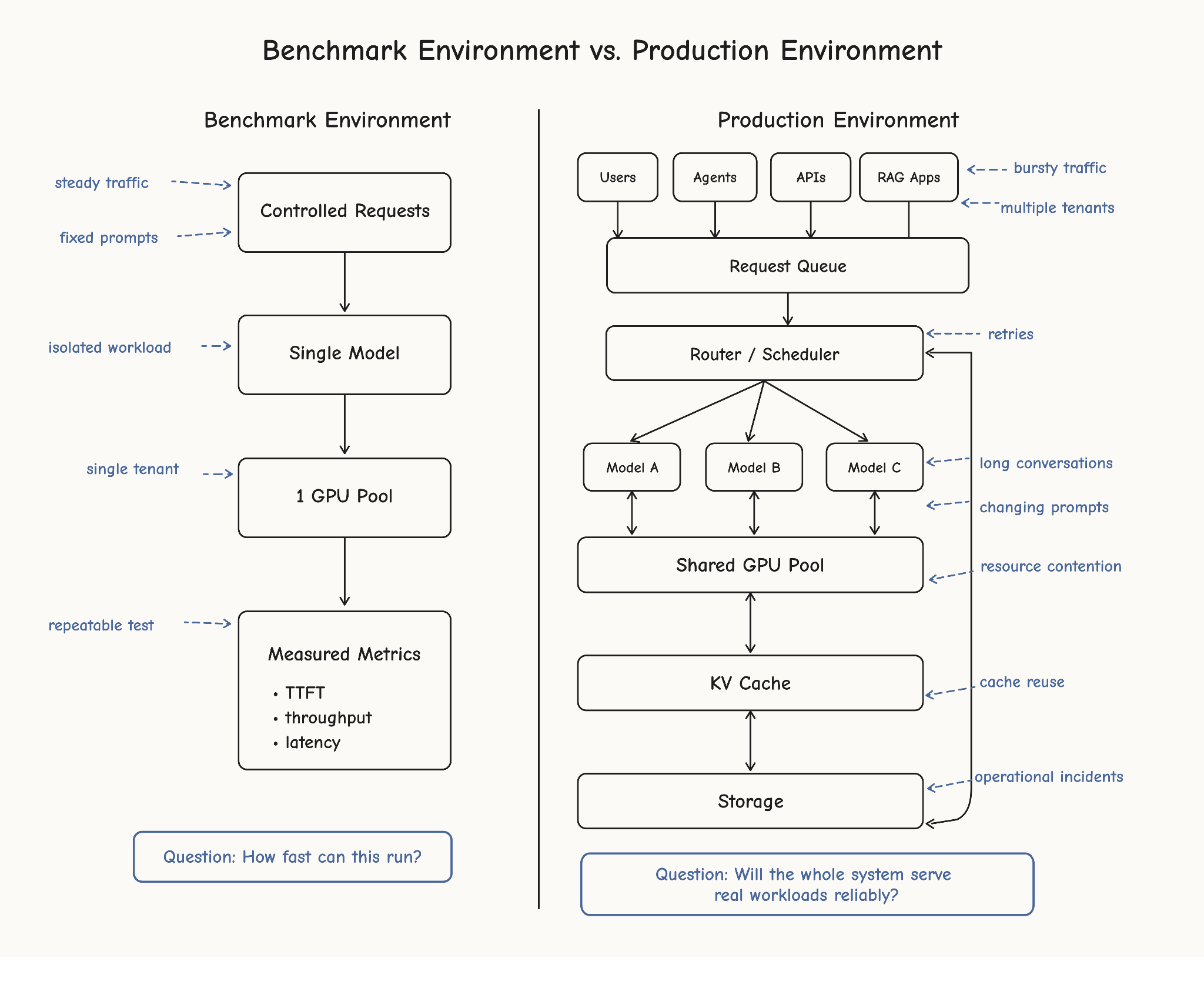
The AI industry pays close attention to benchmark results, but benchmark performance rarely reflects what enterprise customers experience in production.
Most benchmarks evaluate isolated workloads under carefully controlled conditions. Production environments are far more unpredictable. They include fluctuating traffic, long running conversations, retries, multi turn agent workflows, multiple tenants sharing infrastructure, changing prompts, and complex application logic spread across many inference requests.
Because of this, enterprise customers ask a very different question than researchers do. They are not interested in whether a platform achieved the highest benchmark score. They want to know whether it will continue operating reliably at three o'clock in the morning during a holiday weekend when their own customers depend on it.
For production AI, predictable inference latency, operational resilience, and infrastructure reliability consistently matter more than marginal improvements in benchmark scores.
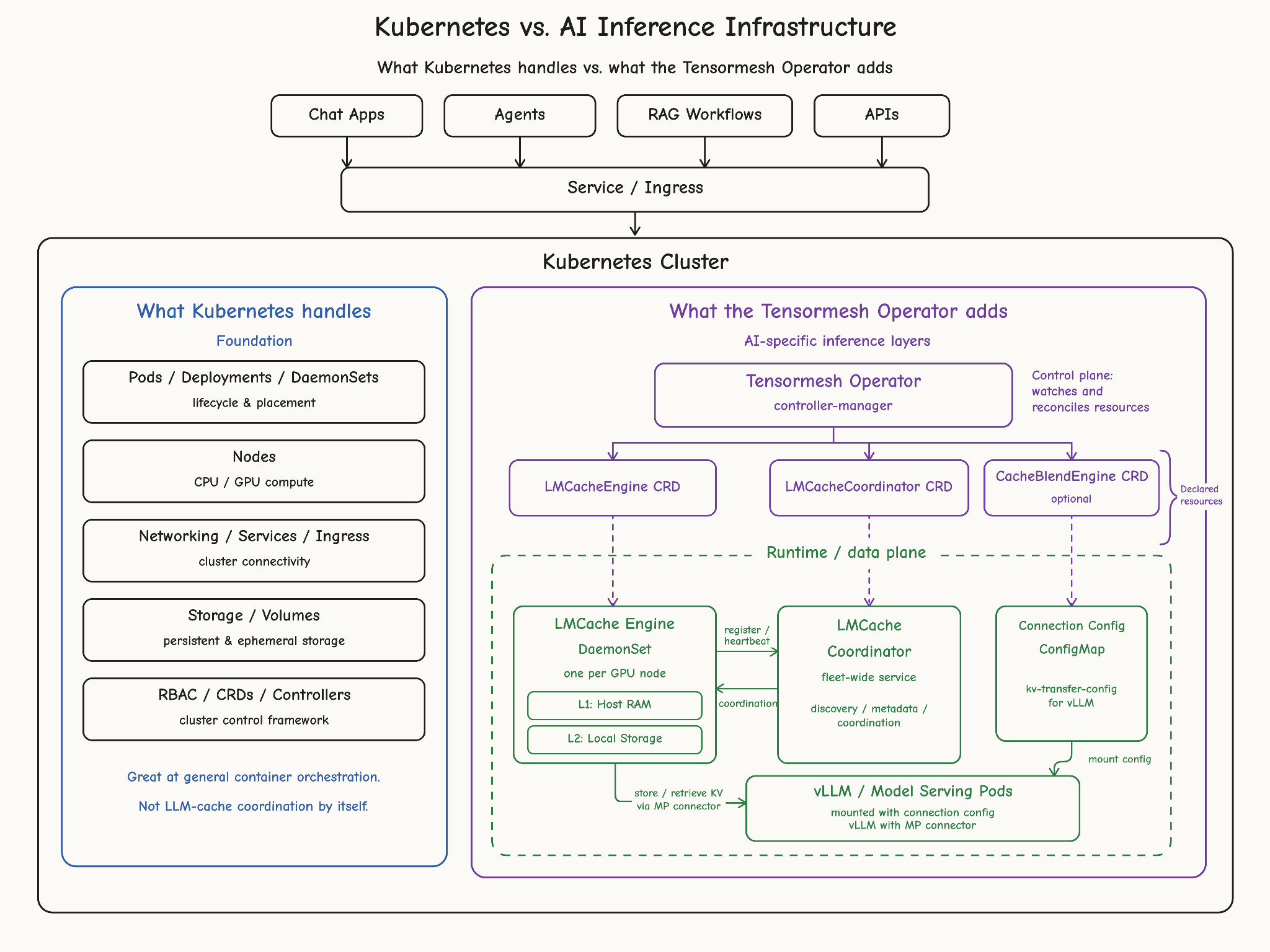
Why Kubernetes Alone Isn't Enough for LLM Inference
Kubernetes has become the foundation of modern cloud infrastructure, but serving large language models introduces challenges that traditional container orchestration was never designed to solve.
LLM inference requires intelligent GPU scheduling, efficient model loading, long running request management, KV cache management, model weight management, and fair resource allocation across multiple tenants. These requirements introduce a level of complexity that extends well beyond deploying containers.
Infrastructure must continuously balance expensive GPU resources while deciding which models remain loaded, what context should remain in memory, when cached data should be reused, and how competing workloads should share limited resources.
Multitenancy makes these decisions even more difficult. Multiple customers may compete for the same GPU memory, cached context, and scheduling priority simultaneously. Preventing noisy neighbors while maintaining high GPU utilization requires infrastructure purpose built for AI inference rather than infrastructure adapted from traditional cloud workloads.
These are engineering challenges many organizations underestimate until they begin operating enterprise AI systems at scale.
Why KV Cache Management Is Becoming Critical for AI Inference
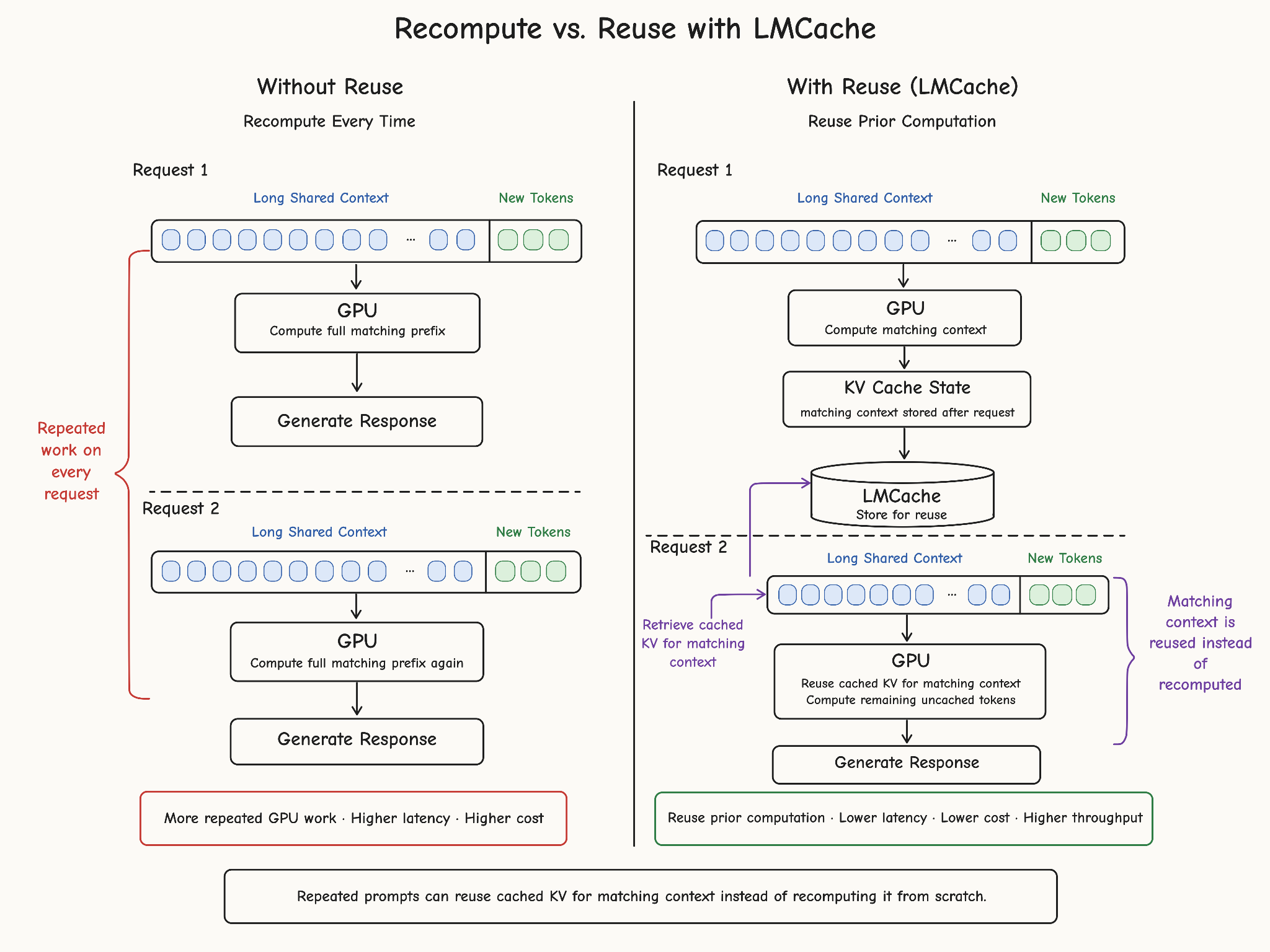
As large language models become increasingly conversational and agentic, KV cache management is becoming one of the most important components of efficient AI inference.
Without intelligent cache reuse, inference systems repeatedly recompute the same prompt context, wasting GPU compute, increasing latency, and driving up infrastructure costs. Efficient KV cache optimization allows organizations to reuse previously computed context, improving cache hit ratios, reducing GPU memory pressure, and serving more requests on the same infrastructure.
Open source projects like LMCache have accelerated innovation around KV cache management by enabling researchers and developers to experiment with new approaches to cache reuse and memory optimization. Bringing those innovations into enterprise production environments, however, requires additional capabilities such as observability, security, tenant isolation, operational tooling, and lifecycle management.
As AI inference workloads continue to grow, intelligent KV cache management will become a foundational capability for organizations seeking to maximize GPU utilization while reducing inference costs.
Open Source Accelerates Innovation. Production Demands Reliability.
Open source has played a major role in advancing AI infrastructure.
Projects like LMCache enable developers to validate new architectures, explore inference optimization techniques, and contribute improvements back to the community. That pace of innovation continues to move the industry forward.
Production users, however, often prioritize different outcomes than research communities. Enterprise engineering teams focus on reliability, observability, security, operational tooling, and predictable performance under real workloads.
Both perspectives are essential. Open source accelerates innovation, while production grade AI infrastructure transforms those innovations into platforms organizations can confidently deploy at scale.
Building Production AI Infrastructure Organizations Can Trust
The AI industry often celebrates larger models, faster inference, and new benchmark records. Those achievements continue to move the industry forward, but they represent only part of the story.
As enterprise AI adoption accelerates, infrastructure is becoming just as important as model quality. Organizations need production ready AI infrastructure that consistently serves real world workloads, maximizes GPU utilization, optimizes GPU memory, reduces inference costs, and scales predictably under production traffic.
From intelligent GPU scheduling and model weight management to KV cache optimization and AI inference orchestration, the next generation of AI platforms will be defined by how efficiently they deliver reliable, scalable LLM inference in production.
Those qualities rarely generate headlines, but they are the characteristics that separate impressive demonstrations from dependable enterprise AI systems.
At Tensormesh, every engineering decision begins with that philosophy. The goal is not simply to make inference faster. It is to build enterprise AI infrastructure that organizations can trust to deliver efficient, reliable, and scalable AI every day.
Have your own 3am infrastructure stories, or thoughts on where AI inference is headed? Follow @𝐓𝐞𝐧𝐬𝐨𝐫𝐦𝐞𝐬𝐡 as we continue sharing what we're learning from building at the edge of production AI.
.png)

.png)